
Bids come in high. The lender wants the number to move. Someone opens a spreadsheet and starts deleting lines. Sound familiar?
Value engineering is a normal part of affordable development, and it isn’t a bad thing. Done well, it finds real savings. Done badly, it quietly strips out the durability and warmth the building needed, and you pay for it in year four when the replacements start.
After 31 years at the table for these meetings, here’s how we keep the savings and protect the building.
Where it’s usually safe to cut
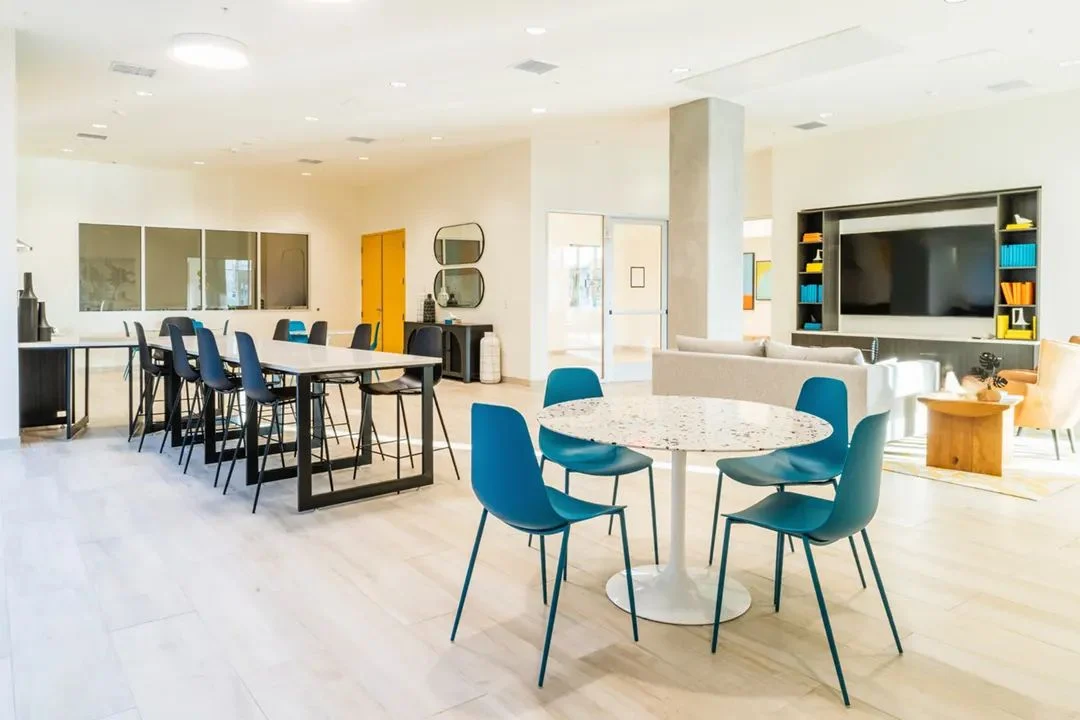
Quantity of decor. Fewer accessories, fewer pillows, fewer framed pieces. Keep the few that matter most in the lobby and community room.
Full height backsplash in every unit. Keep a full height backsplash where people touch it on a tour, like the multipurpose room and restroom. Use a 4″ – 6″ self-splash in the units.
Upgraded cabinet boxes. Residents open the door, not the box. Keep the door style, standardize the box.
Custom millwork in back-of-house areas. Staff offices and storage rooms don’t need custom casework.
The number of amenity rooms. Two well-planned flexible rooms often beat four single-purpose rooms. Combining rooms can save furniture, finishes and square footage all at once.
Ceiling treatments. Decorative ceilings look great in renderings, but most residents look at walls, furniture and light.
Where cutting costs you later
Flooring wear layer. Thin LVT saves a little today and becomes a replacement cycle around year four. This is the most expensive “savings” we see.
Wall protection in corridors. Cutting corner guards and durable wallcovering means repairing drywall forever.
Common-area lighting. Lamps and sconces are what make a room feel like home. Cut them and the lobby starts to feel like a waiting room.
Commercial-grade seating and fabrics. Home-grade furniture in a common room looks worn within a year or two.
Hardware and plumbing fixtures. On affordable, these are durability decisions. Cheap ones mean constant maintenance calls.
The lobby. It’s the first impression for every resident, visitor and inspector, every single day.
How to run a better VE meeting
The question isn’t “what can we delete?” It’s “what’s the cheapest way to keep what matters?”
- Price alternates at design, not at bid. When the options are already priced, the meeting takes an hour instead of a month.
- Compare lifecycle, not just first cost. Put the replacement year next to every price.
- Keep the look, change the product. There’s almost always a less expensive product that holds the same design intent.
- Keep a VE log. Every change, who approved it and why. It prevents surprises and helps the next project.
- Have someone defend the spec. The designer should be in the room explaining what each cut really costs over time.
A quick scorecard for any proposed cut
| Question | If yes |
|---|---|
| Will residents see or touch it every day? | Think twice |
| Does it affect how long something lasts? | Think twice |
| Is there a cheaper product with the same look? | Swap the product, keep the design |
| Is it decor or quantity, not quality? | Usually safe to trim |
| Will it show up as a maintenance call? | Keep it |
Small calls, real money
Three finish decisions alone, the decorative backsplash, the cabinet boxes and the corridor flooring, can swing total cost by roughly $400 to $1,200 per unit. Spend in the right places and save in the right places, and you can often hit the number without the building feeling cheaper.
We have sat through a lot of VE meetings. Our favorite ones end with a lower number and a building nobody would guess was trimmed.